
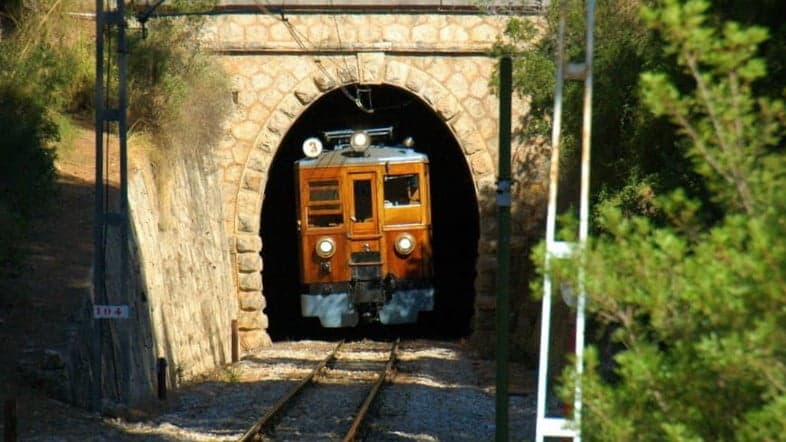
Soller Train: Prices, Timetable and Journey Guide
The wooden railway linking Palma and Soller across the Serra de Tramuntana since 1912, nicknamed the Orange Express. Up-to-date prices, timetable, tickets, stops and everything worth knowing before you board.
- Single Palma - Soller
- €23
- Return
- €30
- Journey time
- ≈ 1 hour
- Train + tram
- €40
Quick summary
- The train leaves from Placa d'Espanya station in Palma and reaches Soller town centre in about an hour: 27.3 km, 13 tunnels and a viaduct.
- A single ticket costs €23 and a return €30; the combined train and tram ticket to Port de Soller costs €40.
- The combined ticket is bought online and you must travel on the train you book; all other tickets are bought at the ticket office on the day.
- There are no seat reservations: arrive 30 minutes early (1 hour in high season).
- Bicycles and electric scooters are not allowed; animals are only accepted if they are guide dogs or in a carrier.
Updated: 31 October 2026
Soller train prices 2026
Official Soller Railway fares, checked on 31 October 2026:
| Journey | Single | Return |
|---|---|---|
| Palma - Soller | €23 | €30 |
| Palma - Bunyola | €11 | €19 |
| Bunyola - Soller | €11 | €19 |
| Combined train + tram (Palma - Port de Soller - Palma) | - | €40 |
The combined ticket includes a return on both the train and the tram on the same day. The tram on its own costs €10 per journey: we cover it in the Soller tram guide.
Prices can change each season, so confirm them on the official website before you travel.
Timetable
There are two timetables a year: the season timetable (until 1 November in 2026) and the winter timetable (from 2 November), with fewer departures. As a guide, for the 2026 season:
- From Palma: first departure at 10:10 and last at 19:40.
- From Soller: first departure at 9:00.
- Some departures are marked "check at the ticket office": confirm them on the day.
The service usually stops for a few weeks in winter for maintenance (typically from mid-December to late January). Always check the official timetable for the day you travel.
Tickets: online, ticket office and conditions
- Online: the official website sells the combined train and tram ticket. After paying, you receive the boarding pass by email. You must travel on the train you book; on the tram you can take any departure.
- Ticket office: all other tickets (single, train only, Bunyola) are bought at the Palma, Bunyola and Soller stations on the day of travel. Card payments are accepted.
- Changes: you can change the date or time of an online ticket until 9:00 on the day of departure.
- Refunds: once issued, tickets are non-refundable.
- Boarding pass not arrived? Check your spam folder and, if it is not there, request a resend from the official website.
- Phone: +34 971 752 028.
The route and stops
The train covers 27.3 km with a climb of around 200 metres. It leaves the modernist station at Placa d'Espanya, crosses the Palma plain and begins to climb towards the Serra d'Alfabia.
- Palma (Placa d'Espanya): the departure station, next to the intermodal train and bus station.
- Son Sardina: a rural parish of Palma.
- Santa Maria and Caubet: halts among carob and almond fields.
- Bunyola: the main intermediate stop, about 30 minutes from Palma, at the foot of the Serra d'Alfabia.
- Pujol d'en Banya viewpoint: a technical stop of about 10 minutes on some special trains so you can photograph the valley. Ask at the ticket office which services stop here.
- Soller: Can Maiol station, two minutes from Placa de la Constitucio.
Shortcut: if you only want the mountain section, board at Bunyola. The Bunyola - Soller journey takes about 25 minutes and costs €11.
Tunnels, viaduct and scenery
The best of the journey is between Bunyola and Soller, where the line cuts through the mountains:
- 13 tunnels, ranging from about 30 metres to almost 3 kilometres. The longest, the Tunel Major, is also the highest point of the line, at around 200 metres above sea level.
- The "500" tunnel, almost half a kilometre long, turns through nearly 180 degrees inside the mountain.
- The "els cinc ponts" viaduct: a curved five-arch stone bridge over the Torrent dels Montreals.
- Scenery: almond trees (in blossom in early February), olive trees on the dry-stone terraces of the Serra de Tramuntana, a World Heritage Site, and, on the descent, the orange and lemon groves of the valley below the Puig del Migdia.
The windows can be opened for photos. In the tunnels a cool, damp air that smells of moss comes in; close them if the noise bothers you.
What the train is like inside
The Soller train keeps its original look from the day it opened: lacquered wooden carriages, sash windows, gilded fittings and leather and metal seats. The seat backs can be flipped so you can sit facing the group or facing the direction of travel. First-class carriages have sofas instead of seats.
There are no seat reservations: seats are taken in order of arrival.
Rules: animals, bicycles and luggage
- Animals: not allowed, except guide dogs or animals in an approved carrier.
- Bicycles and electric scooters: not allowed on board.
- Arrival: the company asks you to be at the station 30 minutes before departure.
- Luggage and accessibility: the official website does not detail the conditions for large suitcases, pushchairs or wheelchairs. As this is a historic train from the 1910s, ask beforehand on +34 971 752 028. With large suitcases the bus is usually more comfortable: we explain it in how to get to Soller.
What to see at the stations
- Palma: a modernist building with depots and workshops. Arrive early to watch the locomotive being coupled to the train, a manoeuvre repeated daily for over a century. In a former garage there is an art exhibition, "50 paisajes de Mallorca".
- Bunyola: a station preserved just as it was built, with its 1929 electrical substation. Nearby are Sa Torre (Villa Francisca, modernist), the s'Alqueria d'Avall possessio and the Alfabia gardens, of Arab origin.
- Soller: Can Maiol, a 17th-century building that has been a fortification, a factory and an inn. Inside, the Fundacio Tren de l'Art has rooms devoted to Miro and Picasso with free entry.
Combining it with the tram to the Port
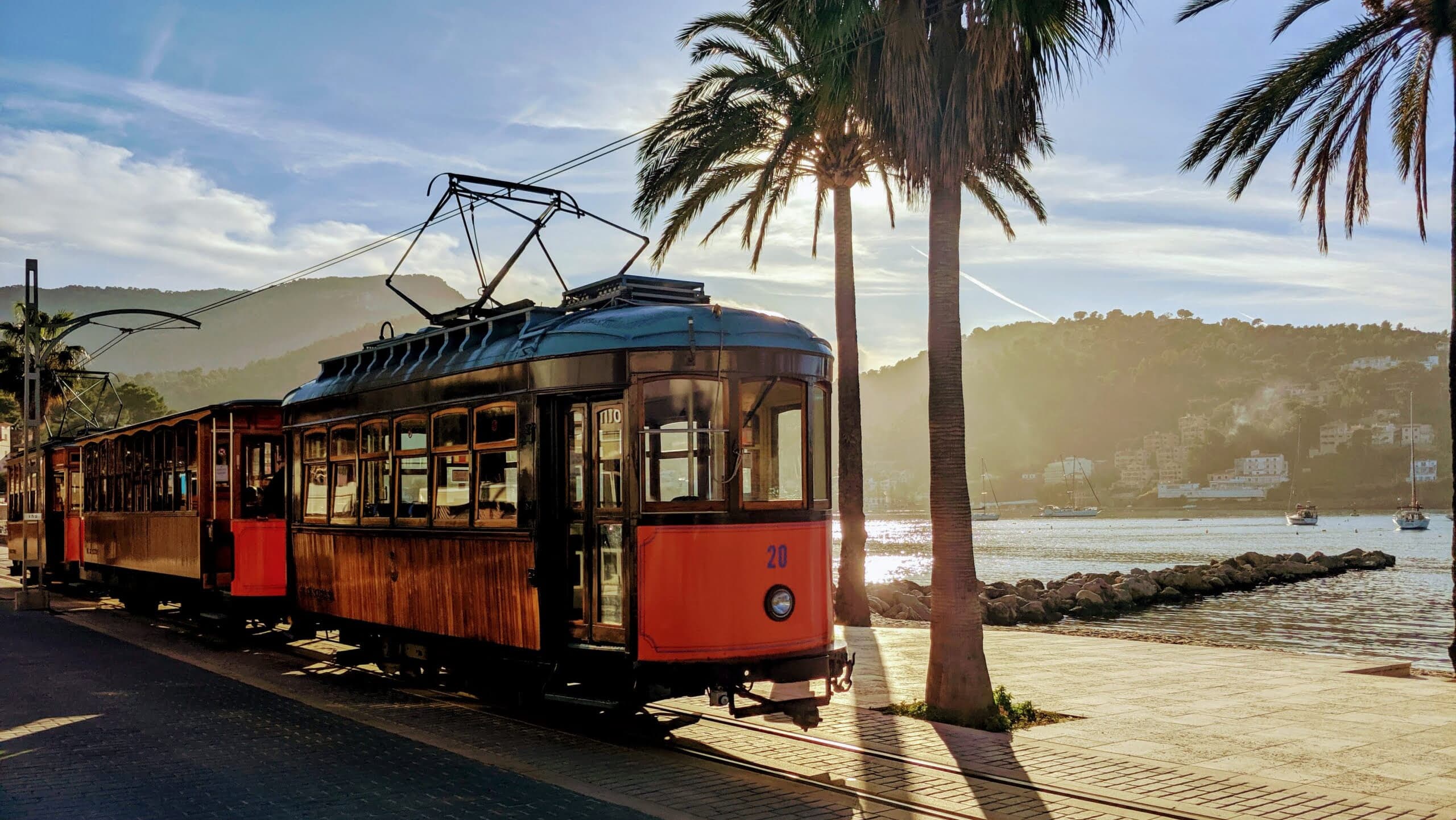
The train ends in Soller town centre. To continue to Port de Soller, take the tram, which leaves right in front of the station. The combined train + tram ticket (€40) covers both journeys, there and back. Route, stops and timetable are in our Soller tram guide.
One-day itinerary from Palma
- 9:30: arrive at Palma station with time to buy tickets and watch the locomotive being coupled.
- Morning: train to Soller and a stroll around the centre: the square, the church of Sant Bartomeu and the shopping streets. We cover it in what to see in Soller.
- Midday: tram to Port de Soller and lunch by the sea.
- Afternoon: a walk around the bay, the tram back and the train to Palma.
If you prefer a quicker or cheaper way back, the Port de Soller - Palma bus is an alternative: see the options in how to get to Soller.
Best time to go
- From May to October the trains are full: book online or arrive with at least an hour to spare. Some travellers miss out on a seat and have to wait for the next train.
- Spring and autumn offer the best balance of weather and crowds. In early February, the almond blossom.
- The first train and the afternoon ones tend to be quieter.
- Check the maintenance closure calendar if you travel between December and January.
History of the Soller Railway
Until the early 20th century, Soller was almost cut off from the rest of Mallorca by the Serra de Tramuntana: to reach Palma you had to climb the Coll de Soller. Its economy, based on exporting oranges to France and the rest of Europe, looked more to the sea than to the capital. To end that isolation, the people of Soller themselves, many with modest contributions, financed a railway with a long tunnel under the mountains.
- 1904: the final route survey is presented.
- 1907: construction begins (3 June).
- 1911: the first train reaches Soller (30 September).
- 1912: official opening of the Palma - Soller line (April).
- 1913: the tram to the Port opens (4 October).
- 1929: electrification is completed (14 July).
- 1973: with serious financial problems, the company even asks to close; tourism ended up saving the line.
- 2019: it exceeds one million passengers a year.
It is one of the few private railways in Spain and keeps its original 914 mm track gauge.
Is the Soller train worth it?
Yes, if you want the experience: the mountain section, the tunnels and the wooden carriages have no equivalent on the island. If you simply need to get to Soller, the bus or a car is quicker and cheaper. A good compromise is to take the train one way and the bus back.
Soller train FAQs
How much is the Soller train?
€23 for the Palma - Soller journey and €30 return. The combined ticket with the tram to the Port costs €40 (2026 fares).
How long does the train from Palma to Soller take?
About an hour for the 27.3 km route. From Bunyola it is about 25 minutes.
Where do I catch the Soller train in Palma?
At Placa d'Espanya station in central Palma, next to the intermodal train and bus station.
Can I buy Soller train tickets online?
Yes, the combined train and tram ticket is sold on the official website for a specific train and day. All other tickets are bought at the ticket office on the day.
Can I change or refund my ticket?
An online ticket can be changed to another date or time until 9:00 on the day of departure. Once issued, it is non-refundable.
How early should I arrive?
The company asks for 30 minutes before departure. In high season an hour is advisable, as there are no seat reservations.
Can I take a dog or a bicycle on the Soller train?
Bicycles and electric scooters are not allowed. Animals can only travel if they are guide dogs or in an approved carrier.
How many tunnels does the Soller train have?
13 tunnels. The longest, the Tunel Major, is almost 3 km long and is the highest point of the line.
Does the train go to Port de Soller?
No. The train ends in Soller town centre; to reach the Port you continue on the tram.
Does the Soller train run in winter?
Yes, on a reduced timetable from November, although it usually stops for a few weeks for maintenance between December and January. Check the official calendar.
Keep exploring
Sightseeing
Soller tram
From the centre to the Port through the orange groves.
View guide →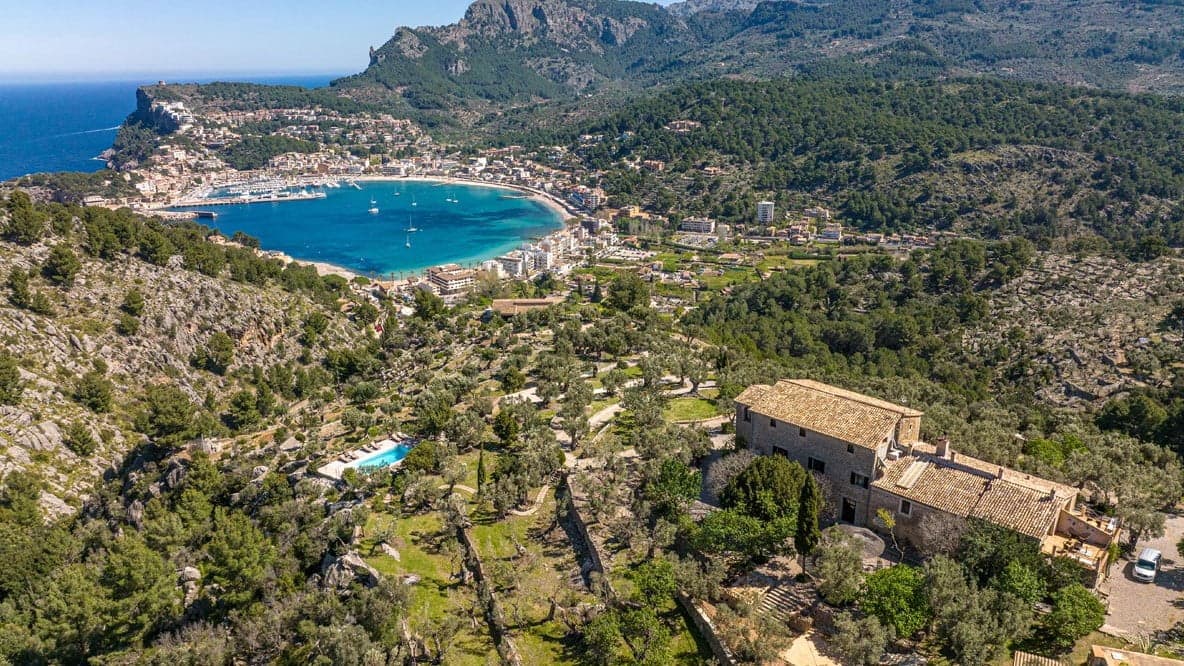
Sightseeing
What to see in Soller
The town's highlights on one walk.
View guide →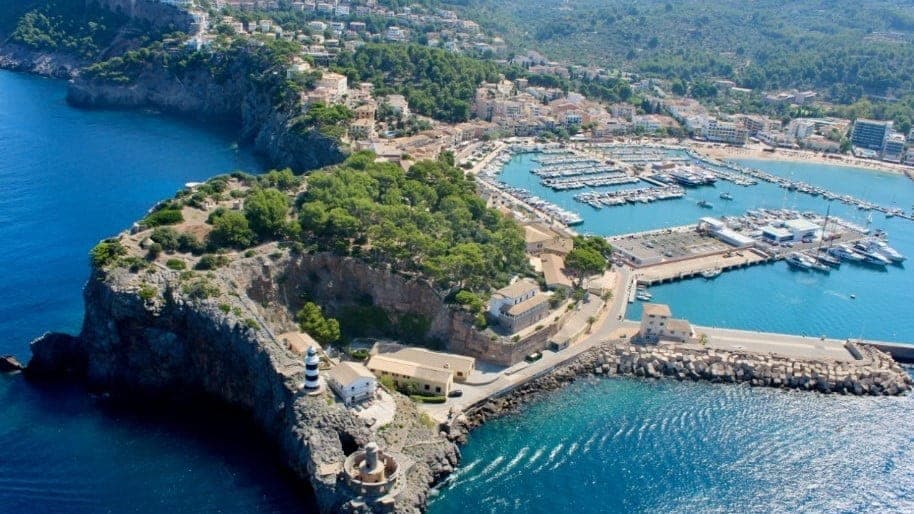
Destination
Port de Soller
The bay, the promenade and the beach.
View guide →
Travel info
Getting to Soller
Bus, car and airport.
View guide →