Soller, Mallorca: History, Facts and Town Life
A valley of orange groves ringed by Mallorca's highest mountains, which for centuries looked to the sea and to France more than to Palma. Here is the whole town: its facts, its history and what it is like today.
- Population (INE 2025)
- 13,882
- Area
- 42.8 km²
- Town status
- Since 1905
- World Heritage
- Tramuntana, 2011
Soller in 6 points
- A municipality in north-west Mallorca, in the Serra de Tramuntana, with 13,882 residents (INE, 1 January 2025) across Soller, Port de Soller, L'Horta and Biniaraix.
- Its valley, ringed by peaks over 1,000 metres, lived cut off from the rest of the island: locals called it 'an island within Mallorca'.
- The name comes from the Arabic place name Sûlyâr, according to the town council. The irrigation channels and the origin of the valley villages date from the Islamic period.
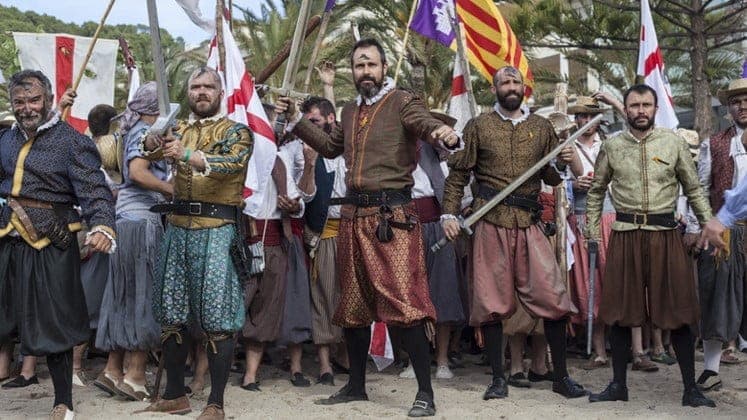
- On 11 May 1561 it fought off a corsair raid, the battle that the Es Firó festival recalls every May.
- In the 19th century it shipped oranges to France. The farming crisis sent hundreds of locals to France and the Americas, and their money paid for the Banc de Sóller, the modernist buildings and the 1912 railway.
- Today it lives from tourism, still grows oranges and olives and speaks a Catalan with French loanwords. It became a city in 1905.
Updated: 3 November 2026
Soller in figures: key facts
| Fact | Value |
|---|---|
| Location | North-west Mallorca, Serra de Tramuntana district (Balearic Islands) |
| Municipal population | 13,882 (INE, 1 January 2025) |
| Area | 42.8 km² |
| Density | About 324 people per km² |
| Altitude of the town | 45 m on average according to the town council; 56 to 59 m in other sources |
| Settlements | Soller, Port de Soller, L'Horta and Biniaraix |
| Neighbouring municipalities | Bunyola, Deià, Fornalutx and Escorca |
| Name for locals | Solleric (sollerica) |
| Postcode | 07100 (Soller) |
| Patron saint | Sant Bartomeu (St Bartholomew), festivities in August |
| Official languages | Catalan and Spanish |
| City status | 1905, granted by King Alfonso XIII |
| Twin town | Port-Vendres (France), since 2018 |
According to the Catalan Wikipedia, citing the 2025 register, the town of Soller has 9,392 residents, L'Horta 1,664 and Biniaraix 455. Population figures vary by source and year: here we use the latest INE figure.
Where Soller is and what the valley is like
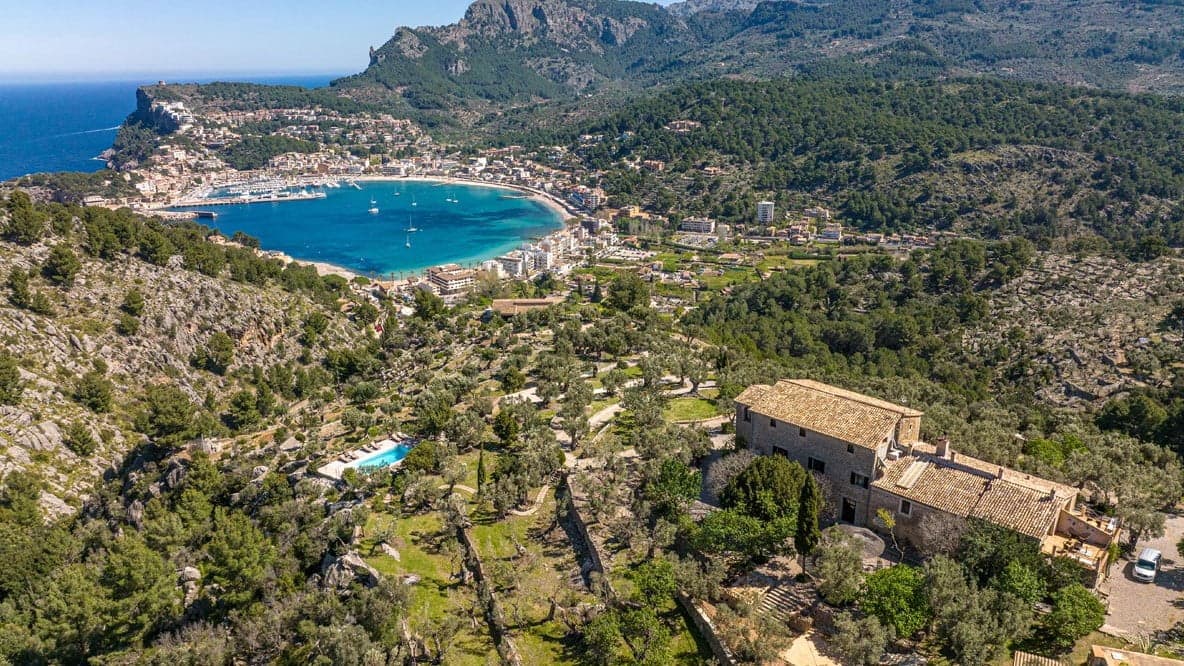
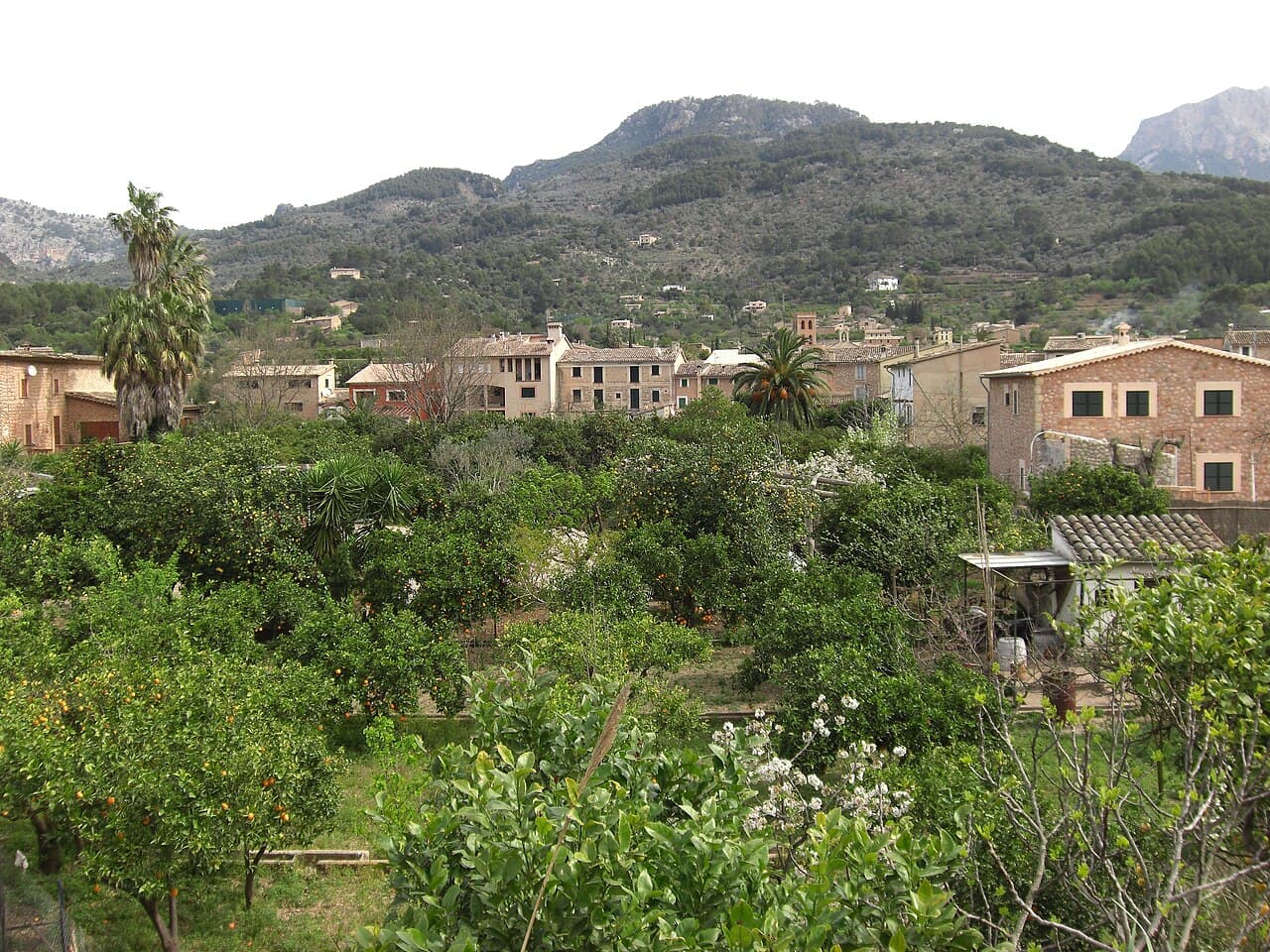
Soller sits in an amphitheatre-shaped valley on the north-west coast of Mallorca. Some of the island's highest peaks surround it: Puig Major (1,436 m, the highest in Mallorca), the Serra d'Alfàbia (1,069 m) and the Teix massif (1,062 m). Towards the sea the valley opens only through a narrow gap that leads to the bay of Port de Soller, about 3 km from the centre.
Water explains almost everything: the torrent Major runs through the valley to the port, and springs such as s'Olla and la Lladonera fed the orchard channels for centuries. That is why oranges and lemons grow here, unusual in dry Mallorca.
Until the 20th century the only land route out was the Coll de Sóller pass (497 m), with more than 60 bends according to the town council. That isolation turned the valley towards the sea: it was easier to sail to France than to take a cart to Palma. Since 2011 the Serra de Tramuntana has been a UNESCO World Heritage cultural landscape.
Cover photo: INDALOMANIA, Wikimedia Commons, CC BY-SA 3.0.
History of Soller: from prehistory to the 21st century
Prehistory and antiquity
Prehistoric remains have been found at Muleta, near the Port, dated by the Spanish Wikipedia to between 5200 and 2700 BC. Three bronze figurines from Roca Roja (4th to 3rd century BC) are now held by the Museu de Mallorca.
Islamic period (10th to 13th century)
Under Muslim rule the valley was organised into alqueries (farmsteads) around the springs, with irrigation channels and water mills. The main ones grew into today's Soller, Biniaraix and Fornalutx, and some streets in the centre still follow that layout. The town's name comes from the Arabic place name Sûlyâr, according to the town council.
Conquest and Middle Ages
After King James I conquered Mallorca in 1229, the valley's land was shared out among the new settlers. The first church, dedicated to St Bartholomew, already stood by the mid-13th century. In the Port the oratory of Santa Caterina d'Alexandria was built; today it houses the Museu de la Mar.
Pirates and defence (16th and 17th century)
The open coast was a danger: in 1542 pirates destroyed the Santa Caterina oratory, rebuilt in 1550. On 11 May 1561 a fleet of Turkish-Algerian corsairs landed in the Port and attacked the town. The locals drove them back, and that victory is the origin of the Es Firó festival. Defences followed, such as the Torre Picada (1614-1623) and the Port castle. Only one stretch of the town wall survives, next to the church.
Oranges, textiles and France (18th and 19th century)
According to a study of the citrus trade, in 1774 the port of Soller was licensed for export, and the valley's oranges began to reach the French ports of Sète and Marseille. During the industrial revolution Soller had up to twelve factories, mostly textile, selling in Mallorca and France. In 1837 Fornalutx became a separate municipality for good.
Crisis and emigration (late 19th and early 20th century)
A farming crisis ruined citrus production in the second half of the 19th century. Many locals emigrated: first to Languedoc and then to the rest of France, following their oranges, and also to Puerto Rico, Cuba and South America, as well as Belgium, Germany, Luxembourg and Switzerland. Many came back with money and invested it in the valley.
Soller's Belle Époque (1885-1913)
That money changed the town in a few years:
- 1885: Joan Marquès i Arbona founds the weekly Sóller, one of Mallorca's oldest local papers.
- 1889: the Banc de Sóller is founded with emigrants' capital.
- 1904: work starts on the church of Sant Bartomeu, with the modernist façade by Joan Rubió, a pupil of Gaudí.
- 1905: King Alfonso XIII grants Soller city status, and the Soller-Palma railway company is formed.
- 1909-1912: the modernist Banc de Sóller building and the Can Prunera house are built.
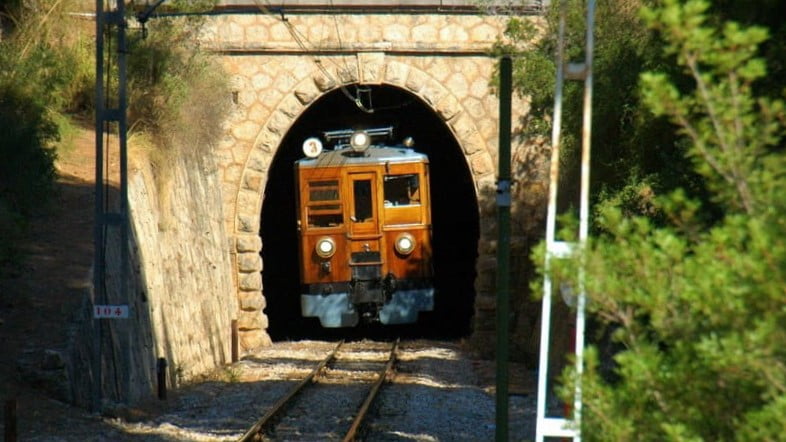
- 1911-1912: the first train reaches Soller on 30 September 1911 and the line officially opens in 1912. Locals paid for much of it. Full story in the Soller train guide.
- 1913: on 4 October the tram to the Port opens, the first electric tram in Mallorca.
20th and 21st century
The post-war years hit hard: the Enciclopèdia Catalana gives 9,377 residents in 1950, and recovery only came after 1960. Since then tourism has transformed the Port and become the main economic activity. Other key dates: the Sa Mostra folk festival began in 1980, the Jardí Botànic opened in 1985, the Soller tunnel opened on 19 February 1997 (toll-free since 2018), and in 2011 the Tramuntana joined the UNESCO list.
Economy: from orange groves to tourism
For centuries Soller lived from the land (citrus, olives and vegetables) and from trade by sea, with a sizeable textile industry in the 19th century. Today the main activity is tourism, along with spending by foreign residents.
Farming has declined because of low prices, but it is still alive: the orange groves of L'Horta, olive mills (tafones) still in use, and cooperatives selling the valley's oranges and oil. Soller oranges and other products have their own guide: oranges and local produce.
Soller and France: a bond unique in Mallorca
No other town in Mallorca had such strong ties with France. Oranges went by sea to Sète and Marseille, emigrants opened fruit businesses in southern France and many families lived between the two countries.
That history is still visible: in the houses of emigrants who returned rich, especially on the Gran Via; in the French loanwords of the local speech; and in the twinning with Port-Vendres, signed in 2018. The anecdotes are in Soller curiosities.
Heritage and modernism
Soller is considered the cradle of modernism in Mallorca. The key buildings are a few steps apart: the façade of the church of Sant Bartomeu and the Banc de Sóller, both by Joan Rubió, and Can Prunera, now a modernist museum. Add the Casal de Cultura (1640), home of the Museu de Sóller, the Museu de la Mar in the Port and the Jardí Botànic.
What to see, in what order and how long to spend at each place is in the what to see in Soller guide.
Language, press and festivals
Language: the official languages are Catalan and Spanish. On the street people speak solleric, the local form of Mallorcan, with the article es/sa and words borrowed from French through emigration.
Local press: Soller has two weeklies, Sóller (1885), the older one, and La Veu de Sóller (1989).
Main festivals:
- Es Firó (May): the Moors and Christians battle recalling the 1561 raid.
- Sant Bartomeu (August): patron saint festivities, with a correfoc fire run.
- Sant Antoni (January): bonfires and the blessing of animals.
- Three Kings (January): procession from the Port to the centre.
- Sa Mostra: international folk festival, since 1980.
The full calendar, with each year's dates, is in the Soller events calendar.
The settlements: Soller, the Port, L'Horta and Biniaraix
- Soller: the town, with the square, the church, the market and the train station.
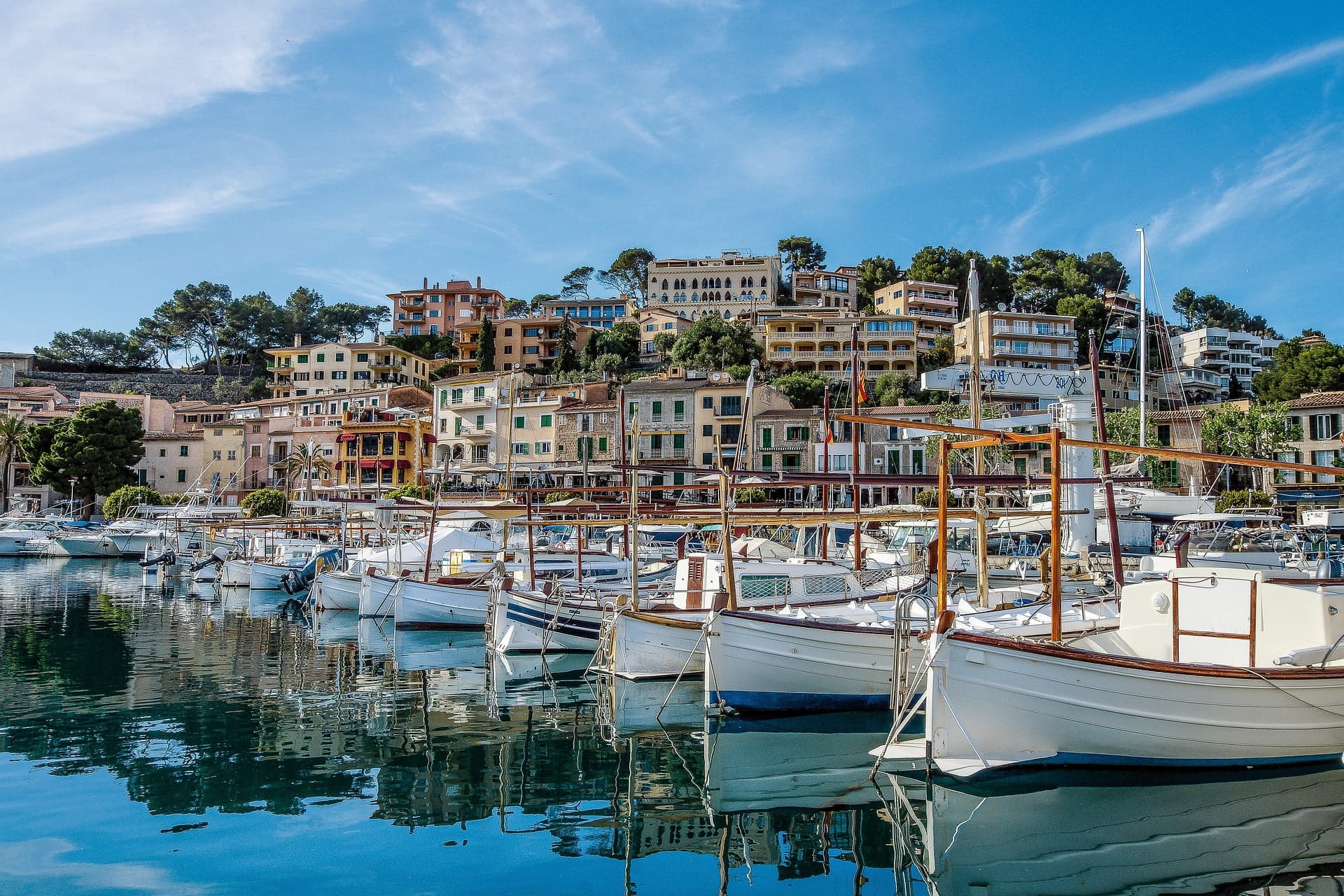
- Port de Soller: the bay, the promenade, the beaches and the lighthouses, about 3 km away.
- L'Horta: the orchards and scattered houses of the valley, among the orange trees.
- Biniaraix: a small stone village at the foot of the gorge that climbs towards Cornadors.
Fornalutx has been a separate municipality since 1837, but it shares the valley. To visit these villages, see day trips from Soller and hiking in Soller.
Climate and getting there
The valley has a Mediterranean climate, with warm summers and mild winters that are wetter than in the south of the island because of the mountains. Month-by-month temperatures and the forecast are in Soller weather.
From Palma you arrive on the Ma-11 through the tunnel, by TIB bus or on the historic train. All options, compared, in getting to Soller.
Notable people from Soller
- Gregori Bausà (1590-1656), Baroque painter.
- Joan Marquès i Arbona (1861-1955), businessman and founder of the weekly Sóller.
- Mateu Colom i Canals (1879-1933), bishop of Huesca from 1922 to 1933.
- Albert Hauf (1938), medievalist and professor of Catalan philology.
- Joan Miquel Oliver (1974), musician and writer, member of Antònia Font.
Sources
This page brings together data from the Soller town council, the INE (register at 1 January 2025), the Enciclopèdia Catalana, the Catalan, Spanish and English Wikipedia, the official Ferrocarril de Sóller website, and academic studies on emigration from Soller to France (Cercles journal) and Puerto Rico (University of Puerto Rico). Where sources disagree, the text says so. Checked on 3 November 2026.
Frequently asked questions about Soller
Where is Soller?
In north-west Mallorca (Balearic Islands), in a valley of the Serra de Tramuntana, about 3 km from the sea. From Palma you reach it on the Ma-11 through the Soller tunnel.
What is the population of Soller?
The municipality had 13,882 residents on 1 January 2025, according to the INE. That includes Soller, Port de Soller, L'Horta and Biniaraix.
Is Soller a city or a village?
It has held city status since 1905, granted by King Alfonso XIII. In size and atmosphere many describe it as a village.
Where does the name Soller come from?
According to the town council, from the Arabic place name Sûlyâr, from Mallorca's Islamic period.
Are Soller and Port de Soller the same municipality?
Yes. Port de Soller is one of the municipality's four settlements, with Soller, L'Horta and Biniaraix. Fornalutx, however, has been a separate municipality since 1837.
Why is Soller linked to France?
Because in the 19th century it shipped oranges to Sète and Marseille, and the farming crisis led many locals to emigrate to France. Their money paid for the Banc de Sóller, modernist houses and the railway.
What are people from Soller called?
Sollerics (solleric, sollerica).
What is Soller's biggest festival?
Es Firó, in May, which re-enacts the battle against the corsairs of 11 May 1561. The patron saint festivities of Sant Bartomeu are in August.